Polarized vs non-polarized lenses for sports: which one should your range carry?
When polarized lenses help athletes, when they hurt, and how to split a private-label sports sunglasses range between polarized, non-polarized and photochromic options.

Short answer: Polarized lenses block horizontally reflected glare, so they win on water, wet roads, sand and snow. Non-polarized mirrored or contrast lenses are better where athletes must read screens, judge ice or track a ball against a bright sky. Most sports brands carry both: polarized for fishing, running and lifestyle, non-polarized or photochromic for cycling, ball sports and skiing.
What polarization actually does
Sunlight reflecting off a flat surface such as water, a wet road or a car bonnet becomes partly polarized in the horizontal plane. That reflected light is what we perceive as glare. A polarized lens contains a film with vertically aligned molecules that absorbs horizontally polarized light, so glare drops sharply while the rest of the scene stays visible.
That is all polarization does. It does not add UV protection, it does not make a lens tougher, and it does not change the colour of the world. Those properties come from the lens substrate, tint and coatings.
Where polarized lenses win
- Fishing and water sports. Cutting surface glare lets anglers see below the water line. This is the single strongest use case, and it is why almost every fishing model in our fishing sunglasses range ships polarized.
- Running and road training. Wet tarmac and car windscreens throw glare straight at the eyes. Polarized lenses reduce squinting over long sessions.
- Driving and lifestyle. For crossover models sold as everyday sport sunglasses, polarized is what retail customers expect at the shelf.
- Beach volleyball and sand sports. Sand is highly reflective at low sun angles.
Where non-polarized lenses are the better call
- Cycling with a head unit. Bike computers and phone screens can black out at certain angles. Many road and MTB riders also say polarization flattens the texture of the road surface, hiding wet patches and gravel. Our cycling glasses are offered in both versions for that reason.
- Skiing. Polarization can hide the difference between packed snow and ice. Most snow goggles use non-polarized mirrored or contrast lenses. See our ski goggle lens guide.
- Ball sports. In baseball, golf, pickleball and tennis, players need to pick up a fast ball against sky and background. Contrast-enhancing non-polarized tints such as rose, amber or a light blue mirror usually perform better.
- Low-light trail riding. A clear, yellow or photochromic lens lets more light through than any polarized lens.
How to split a private-label range
For a first order with a new sports brand we usually suggest building the range around use, not around lens type:
| Range slot | Recommended lens | Why |
|---|---|---|
| Hero cycling shield | Non-polarized mirror + clear spare, or photochromic | Screen readability, changing light |
| Lifestyle sport wrap | Polarized TAC, smoke or grey | Shelf expectation, glare control |
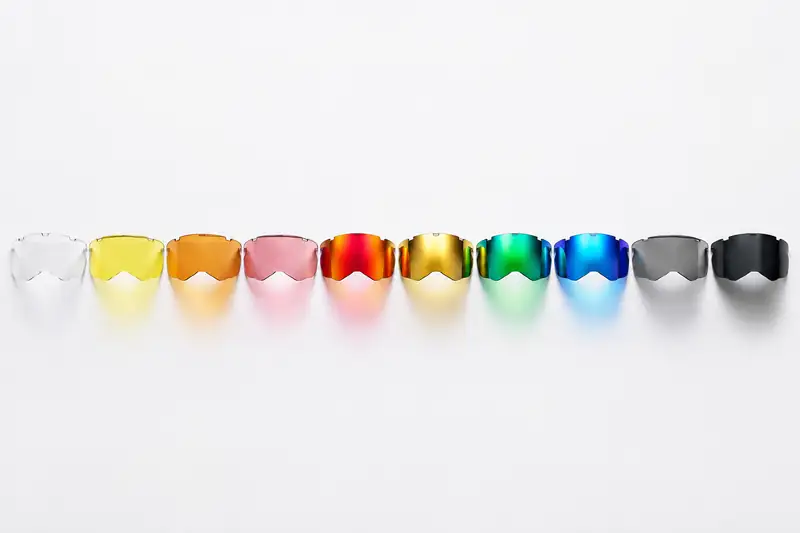
| Fishing / water | Polarized, grey-green or amber base with blue or green mirror | Sight-fishing contrast |
| Ball sports | Non-polarized rose or amber contrast | Ball tracking |
| Snow | Non-polarized, double-layer, anti-fog | Ice visibility, fog control |
Cost and MOQ notes
Polarized TAC lenses add a modest cost per pair compared with plain PC tints. Polarized PC and polarized photochromic lenses cost more again, and photochromic dyes have longer lead times. Because the frame mould is shared, you can usually order the same model with two lens options inside one purchase order, keeping each colourway at the model’s minimum order quantity.
Quick checklist before you approve samples
- Rotate the sample in front of an LCD screen to confirm the polarization axis is correct.
- Check the lens marking and test report states UV400 or 100% UV protection.
- Compare two samples side by side under daylight for tint consistency.
- Ask for the luminous transmittance (VLT) and filter category, which you will need for EU labelling.
If you are unsure which lens suits a model, send us the sport and market and we will sample both versions on the same frame.
Frequently asked questions
Do polarized lenses block more UV than non-polarized lenses?
No. UV protection comes from the lens material and absorbers, not from the polarizing film. A non-polarized UV400 lens blocks UV just as well as a polarized UV400 lens.
Can polarized lenses be photochromic?
Yes. Polarized photochromic lenses combine a polarizing film with light-reactive dyes. They cost more and darken more slowly in cold weather, so we recommend them for driving, fishing and running rather than as a default for every frame.
Why do LCD screens look dark through polarized lenses?
Many screens emit polarized light. When the screen’s polarization angle is crossed with the lens filter, the screen dims or blacks out. Cyclists using bike computers and pilots often prefer non-polarized lenses for this reason.